
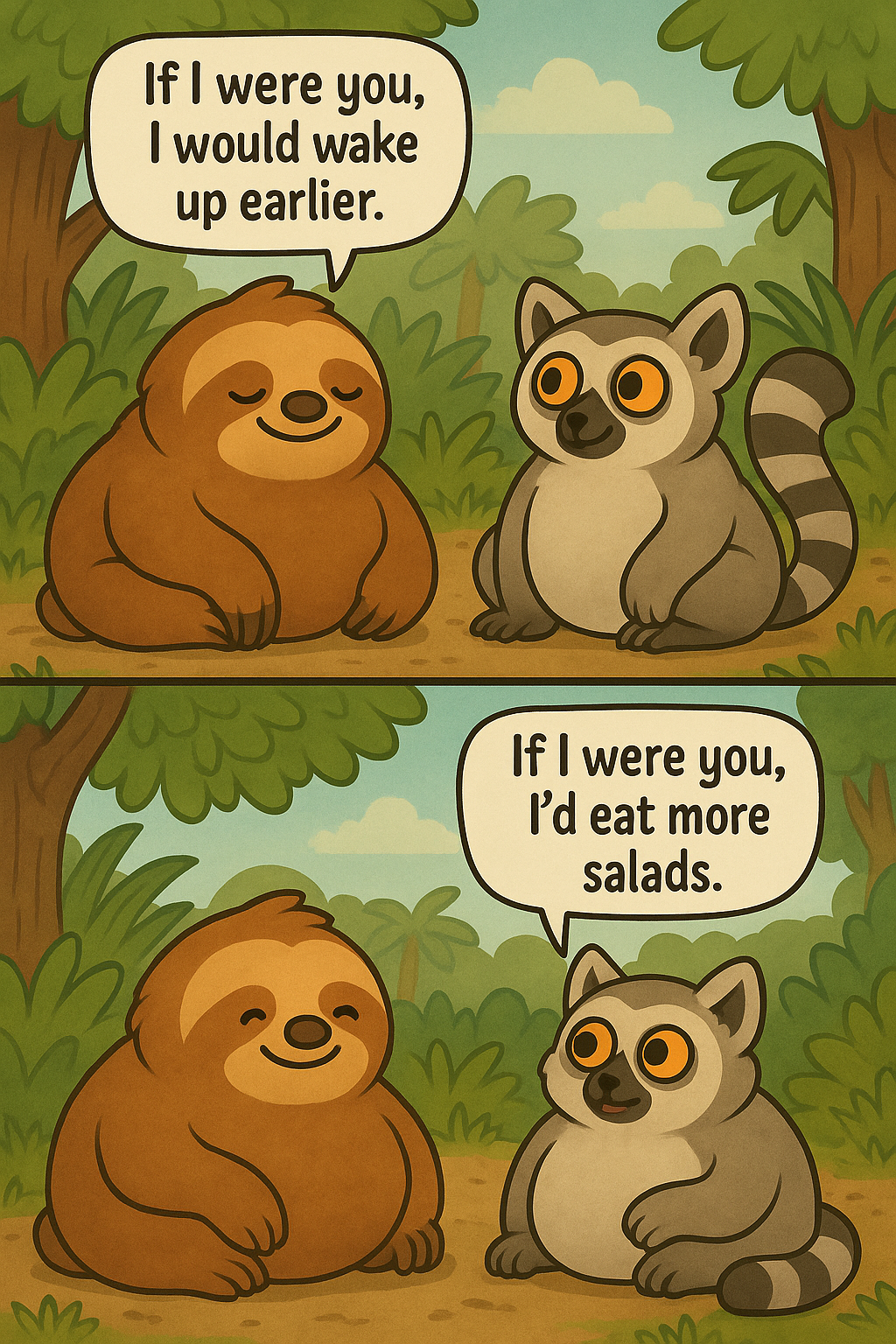
The Second Conditional: Imaginary Situations
📌 Lesson Contents
🎯 Lesson goal
In this lesson you will learn to use the Second Conditional 📖 to talk about imaginary, unreal or unlikely situations. You will see how to form it 🧠, when to use it ✍️ and you can practise straight away with the interactive test at the bottom of the page! 🚀
🌟 What is the Second Conditional?
We use the Second Conditional to talk about unlikely, impossible or purely imaginary situations in the present or future 🔮:
- Imaginary situations: If I had a lot of money, I would travel the world. ✈️🌍
- Imaginary advice: If I were you, I would accept the job. 💡
- Unlikely events: If it rained now, we would stay inside. ☔
🔍 How do we form the Second Conditional?
The structure has two main parts:
IF + Past Simple , WOULD + Base Verb
| If-Clause | Main Clause | Full Example |
|---|---|---|
| If + Past Simple | would + base verb | If she knew the answer, she would tell you. 🧠 |
🔄 Word Order, Contractions and “If I WERE”
- Changing the order: You can swap the two parts without changing the meaning. If the sentence starts with would, we don’t use a comma!
➔ I would travel the world if I had a lot of money. - Contraction of would: In spoken English, would is often shortened to ‘d:
➔ I’d buy a house, he’d help us, she’d come with us. - The verb be (“If I were”): In the formal Second Conditional, the verb be uses were for all persons (including I, he, she, it):
➔ If I were you, I wouldn’t do that. (Formal and recommended)
➔ If I was you… (Accepted in informal speech).
🧩 Summary table – Second Conditional
| “If” part | “Would” part | Example |
|---|---|---|
| If + Past Simple | would + base verb | If I won the lottery, I would buy a house. 🏡 |
| If + Past Simple (negative) | wouldn’t + base verb | If he didn’t study, he wouldn’t pass. 📚 |
❓ Frequent questions
- Is the verb after “if” always in the Past Simple?
➔ Yes! Even though it talks about the present or future, we use the Past Simple. The past form shows that the situation is unreal. - Can I use “will” after “if”?
➔ ❌ Absolutely not! Will is only for the First Conditional. In the Second Conditional we use would in the main clause. - What is the difference between the First and Second Conditional?
➔ The First Conditional (if + present, will + base) is for real and likely situations. The Second Conditional (if + past, would + base) is for imaginary or unlikely situations.
🚫 Common mistakes to avoid
| Mistake ❌ | Correct ✅ |
|---|---|
| If I will have money, I would travel. | If I had money, I would travel. |
| If she knows the answer, she would tell you. | If she knew the answer, she would tell you. |
| If I had money, I would to buy a car. | If I had money, I would buy a car. (No ‘to’!) |
📌 Remember the golden rule
- ✔️ Second Conditional ➔
If + Past Simple, would + base verb - ✔️ Use it for imaginary situations or advice (If I were you…)
- ✔️ Never put will or would right after IF!
Practise now with the interactive test below! 🔮✨
Gap Fill & Translation Exercises
Test yourself! In the first 15 sentences, write the correct form of the verbs in the Second Conditional. In the last 5, put the sentences into English.