
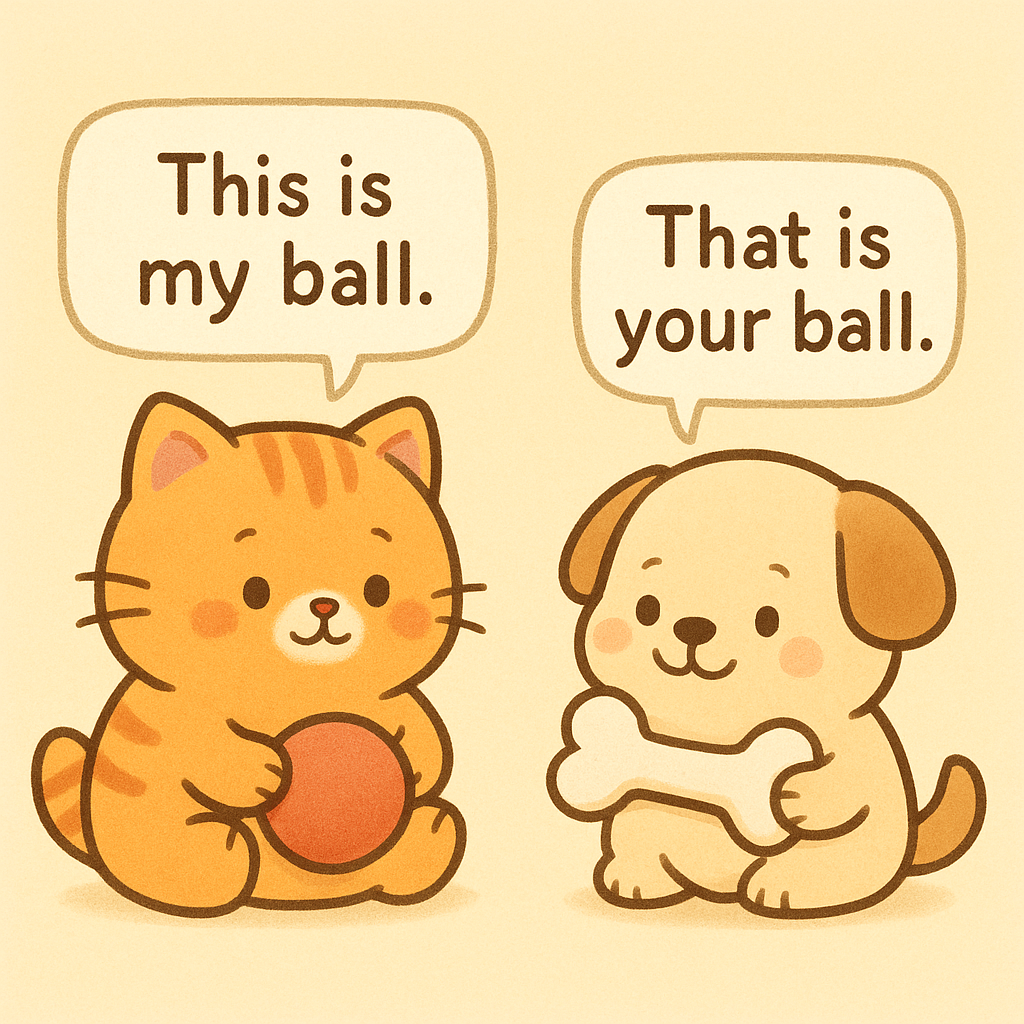
Possessive Adjectives (My, Your, His…)
📌 Lesson Contents
🎯 Lesson goal
In this lesson you will learn to use possessive adjectives 📖 correctly. You will see what they are 🧠, how to use them ✍️, which traps they hide and which mistakes to avoid 🚫. At the end, you can practise everything with the interactive test! 🚀
🌟 What are possessive adjectives?
Possessive adjectives tell us who something belongs to 🔑. They are words like: my, your, his, her, its, our, their.
In English, possessive adjectives always go before a noun 📚 and they NEVER take an article before them (we don’t say “the my book”, only “my book”).
🔍 Practical examples:
- This is my book. 📖
- Is that your car? 🚗
- His name is John. 👨
- Her dog is cute. 🐶
- Its tail is long. 🐕
- Our house is big. 🏡
- Their parents are nice. 👪
🧩 Complete list of possessive adjectives
| Owner | Possessive | Example |
|---|---|---|
| I | My | My phone is new. 📱 |
| You | Your | Your bag is on the chair. 👜 |
| He | His | His brother is tall. 🧍♂️ |
| She | Her | Her cat is black. 🐱 |
| It (thing or animal) | Its | Its eyes are blue. 👀 |
| We | Our | Our teacher is kind. 👩🏫 |
| They | Their | Their house is beautiful. 🏠 |
❓ Basic doubts cleared up (Watch out!)
Many learners often mix up the third person singular. In English the word depends on the owner, not on the thing owned!
- His is for something that belongs to a man or boy ➔ his book (Marco’s book).
- Her is for something that belongs to a woman or girl ➔ her dog (Sara’s dog).
- Its is for animals, things or ideas ➔ its colour (the colour of an object).
🚫 Common Mistakes:
- His does NOT mean “he”! It means “belonging to him”.
- Her does NOT mean “she”! It means “belonging to her”.
- Don’t mix up it’s and its!
➔ It’s = It is (e.g. It’s raining)
➔ Its = possessive adjective (e.g. The dog wags its tail)
Grammar Challenge 📝
The only way to really learn a rule? Practise!
Write the correct possessive adjective in the first 15 sentences, and put the last 5 into English.