
Must, Have to, Mustn’t e Don’t Have to
📌 Lesson contents
🎯 Lesson goal
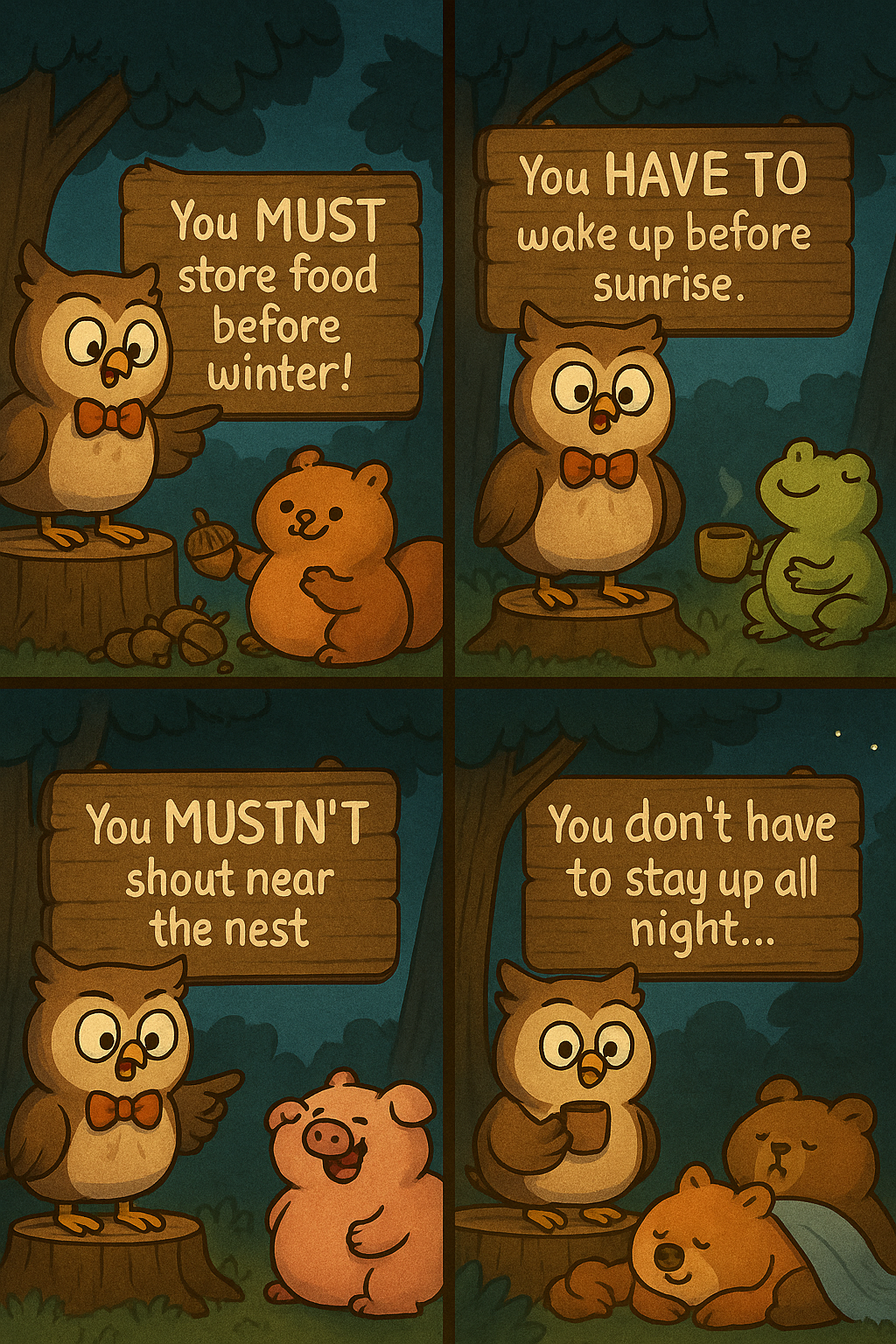
In this lesson you will learn to use must, have to, mustn’t and don’t have to 📖 to talk about obligation, prohibition and no obligation. You will see when to use them, how to build the sentences 🧠 and start real practice with the test at the bottom of the page! 🚀
🌟 What do must, have to, mustn’t, don’t have to mean?
- Must ➔ you need to do something (strong, personal obligation, from inside) ✅
- Have to ➔ you need to do something (general obligation, from outside or from rules) ✅
- Mustn’t ➔ you are absolutely not allowed to do something (strong prohibition) ❌
- Don’t have to ➔ you are not obliged to do something, it is not necessary (free choice) 🆓
🔍 How do we use them?
| Modal | Meaning | Example |
|---|---|---|
| Must | Strong, personal obligation | You must wear a helmet. ⛑️ |
| Have to | External or general obligation | I have to go to work at 8. 🏢 |
| Mustn’t | Strong prohibition | You mustn’t smoke here. 🚭 |
| Don’t have to | Not necessary / not obligatory | You don’t have to come if you don’t want to. 🛋️ |
🔍 Practical examples
1. MUST (you need to)
✅ An obligation the speaker feels strongly, personally or morally.
- You must study hard for the exam. 📚
- I must call my mum. ☎️
2. HAVE TO (you need to)
✅ An obligation that comes from a rule, a law, a timetable or someone else.
- I have to pay the bills. 🧾
- She has to wear a uniform at school. 🎒
3. MUSTN’T (you must not)
✅ Strong prohibition: it is forbidden or dangerous.
- You mustn’t drive without a licence. 🚗❌
- Students mustn’t cheat during exams. 📄❌
4. DON’T HAVE TO (not obliged)
✅ No obligation: it is not necessary, and you can choose freely. It means “it is not required”.
- You don’t have to wear a tie. (You can if you want to.) 👔🆓
- We don’t have to wake up early tomorrow. ⏰🛌
🧩 Summary table – Must / Have to / Mustn’t / Don’t have to
| Modal | When to use it | Example |
|---|---|---|
| Must | Personal or moral obligation | You must tell the truth. 🧠 |
| Have to | Obligation from a rule or an outside situation | I have to work on weekends. 🏢 |
| Mustn’t | Strong prohibition | You mustn’t enter here. 🚫 |
| Don’t have to | No obligation, free choice | You don’t have to answer now. 🧘♂️ |
❓ Basic doubts cleared up
- Are must and have to always the same?
➔ Almost! But must shows a duty the speaker feels strongly and personally, while have to is more neutral or comes from outside laws and rules. - How do we make “have to” negative?
➔ With don’t have to (or doesn’t have to). Careful: it means “not obliged”. It does NOT mean “forbidden”! - How do we make questions?
➔ With Must: Must I leave now?
➔ With Have to: Do you have to work tomorrow? / Does she have to go?
🚫 Common mistakes to avoid
| Mistake ❌ | Correct ✅ |
|---|---|
| You must to study. | You must study. (No ‘to’ after must!) |
| He mustn’t to park here. | He mustn’t park here. (No ‘to’ after mustn’t!) |
| You don’t have study. | You don’t have to study. (Have to always needs ‘to’!) |
👉 Remember: modal verb + base verb (without “to”), except with have to!
📌 Final summary
- Must ➔ strong, personal obligation.
- Have to ➔ general or external obligation.
- Mustn’t ➔ strong prohibition.
- Don’t have to ➔ freedom, no obligation.
Practise by talking about what you must, mustn’t or can choose to do every day! ✨
Gap Fill & Translation Exercises
Test yourself! In the first 15 sentences, fill in ‘must’, ‘have to’, ‘has to’, ‘mustn’t’ or ‘don’t have to / doesn’t have to’. In the last 5, say the sentence in English using the clue.