
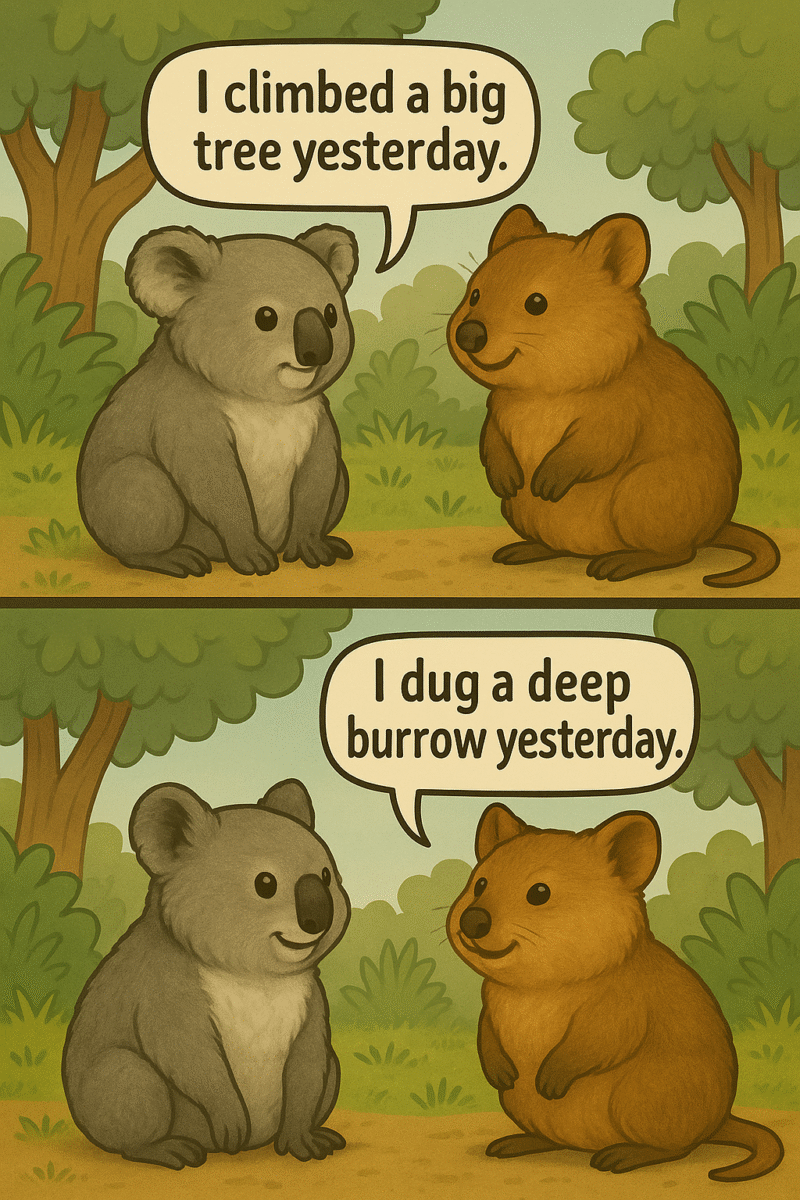
Past Simple: Regular Verbs
📌 Lesson contents
🎯 Lesson goal
In this lesson you will learn to use the Past Simple with regular verbs 📖 to talk about finished actions in the past. You will see how to make positive, negative and question sentences 🧠, how to pronounce the -ed ending, and the most common mistakes to avoid, before testing yourself with the quiz at the bottom of the page! 🚀
📚 When do we use the Past Simple?
We use the Past Simple to:
- Describe finished actions in the past 🕰️
- Tell events in order (like a story) ✍️
- Talk about situations with no link to the present ⛔️
Typical time expressions: yesterday, last night, last week, in 2001, two days ago…
Examples:
I visited London last year. 🇬🇧
She cooked dinner yesterday. 🍝
✅ How we form the Past Simple (regular verbs)
👉 Positive sentences: Subject + verb + -ed
| Subject | Base verb | Past Simple sentence |
|---|---|---|
| I | play ⚽️ | I played football. |
| She | watch 🎬 | She watched a movie. |
- For verbs that end in -e, add only -d (e.g. live → lived).
- For verbs that end in consonant + y → change the y to i and add -ed (e.g. study → studied).
❌ Negative sentences: Subject + did not (didn’t) + base verb
| Negative sentence | Full form |
|---|---|
| I didn’t play football. | I did not play football. |
| She didn’t watch TV. | She did not watch TV. |
💡 Note: The verb goes back to the base form, because the past is already shown by the auxiliary “did”.
❓ Questions: Did + subject + base verb?
| Question | Short answer |
|---|---|
| Did you like it? | Yes, I did. |
| Did she study English? | Yes, she did. |
🧩 Summary table
| Type of sentence | Structure | Example |
|---|---|---|
| Positive | S + verb + -ed | They visited Rome. |
| Negative | S + didn’t + base verb | We didn’t work. |
| Question | Did + S + base verb? | Did you call me? |
🔊 Pronouncing verbs that end in -ed
There are 3 ways to pronounce the -ed ending in English:
| Sound | When we use it | Example |
|---|---|---|
| /t/ | After voiceless sounds (p, k, f, s, sh, ch…) | watched 🎬, danced 💃 |
| /d/ | After voiced sounds (l, n, g, v, b, vowels…) | played 🎮, opened 🚪 |
| /ɪd/ | After the sounds t or d | wanted 🎯, needed 🆘 |
🌍 Past Simple or Present Perfect?
Many languages use a “have + past participle” form for finished actions in the past: “I have played”.
In English, for a finished action in the past with a definite time, we always use the Past Simple: ➔ I played.
❌ Don’t say I have played for finished events with a definite past time!
🚫 Common mistakes to avoid
| Mistake ❌ | Correct ✅ |
|---|---|
| She play yesterday. | She played yesterday. |
| Did you played? | Did you play? |
| I didn’t went. | I didn’t go. |
🗂️ Common regular verbs & mini-dialogues
A1 list of regular verbs
| Base verb | Past Simple | Meaning |
|---|---|---|
| play 🎮 | played | to take part in a game or sport |
| watch 🎬 | watched | to look at TV or a film |
| open 🚪 | opened | the opposite of ‘close’ |
| study 📚 | studied | to learn from books |
| clean 🧼 | cleaned | to make something tidy, not dirty |
| cook 🍳 | cooked | to make food with heat |
| dance 💃 | danced | to move your body to music |
| live 🏠 | lived | to have your home in a place |
🗣️ Mini-dialogues
| 🇬🇧 English | 👀 Spot the verbs |
|---|---|
| A: Did you visit Paris? 🗼 B: Yes, I visited last summer. ☀️ | Did you visit ➔ visited |
| A: What did she cook? 🍽️ B: She cooked pasta. 🍝 | What did she cook ➔ cooked |
| A: They didn’t work yesterday. 💤 B: Did you study last night? 🌙 | didn’t work | Did you study |
Gap Fill & Translation Exercises
Test yourself! In the first 15 sentences, write the correct Past Simple. In the last 5, write the sentences in English from the situations given.