
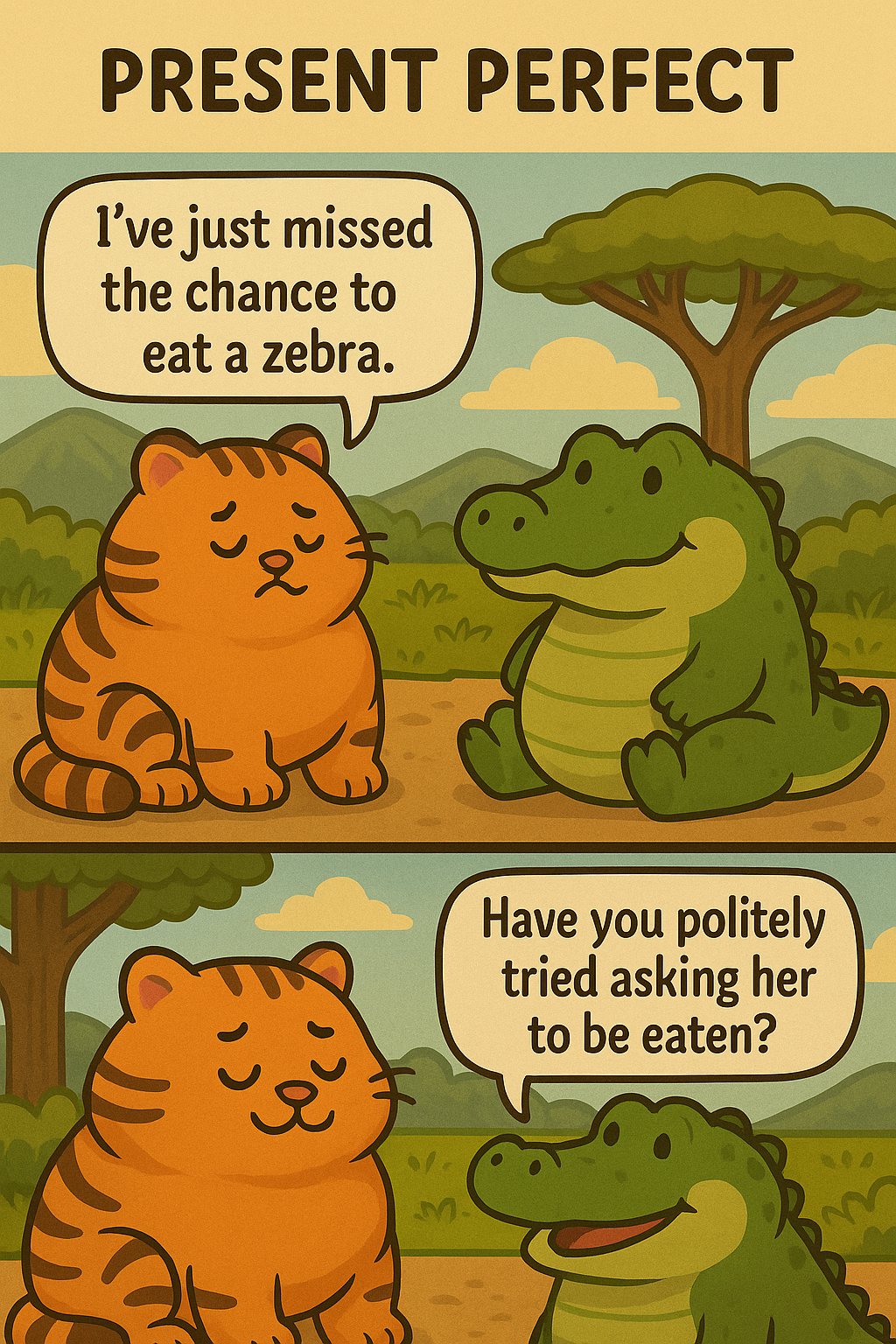
The Present Perfect: Experiences and Recent Actions
📌 Lesson contents
🎯 Lesson goal
In this lesson you will learn to use the Present Perfect 📖 to talk about life experiences, recent actions and the link between the past and the present. You will see how to build it 🧠, when to use it ✍️, and you will get real practice right away with the interactive quiz at the bottom of the page! 🚀
🌟 What is the Present Perfect?
The Present Perfect connects the past with the present 🔗. We use it mainly for three reasons:
- Life experiences 🧳: Actions that happened at an unspecified time in the past.
Example:I have visited Japan. - Recent actions 🕒: Something that has just happened.
Example:They have just arrived. - Connection to the present 🔑: A past action with a clear result now.
Example:I have lost my keys.➔ (And now I can’t get in!)
🔍 How do we form the Present Perfect?
The basic rule is simple:
Subject + HAVE / HAS + Past participle
| Subject | Auxiliary | Past participle | Example |
|---|---|---|---|
| I / You / We / They | have (‘ve) | worked / eaten / gone | We have eaten lunch. 🍽️ |
| He / She / It | has (‘s) | worked / eaten / gone | She has gone to the store. 🛒 |
💡 Watch out for the past participle:
- Regular verbs: add -ed (e.g.
work ➔ worked,visit ➔ visited). - Irregular verbs: use the 3rd column of the verb list (e.g.
go ➔ gone,eat ➔ eaten,see ➔ seen).
⏱️ Common key words with the Present Perfect
| Word | Meaning | Position | Example |
|---|---|---|---|
| Just | a very short time ago | Between have/has and the past participle | I have just finished. |
| Already | before now (sooner than expected) | Between have/has and the past participle | She has already left. |
| Yet | up to now (negatives) / already? (questions) | At the end of the sentence (negatives/questions) | Haven’t you finished yet? |
| Ever / Never | at any time in your life (questions) / not at any time (never) | Between have/has and the past participle | Have you ever been to Rome? |
🧩 Summary table – Present Perfect
| Form | Structure | Example |
|---|---|---|
| Affirmative | Subject + have/has + Past Participle | He has finished his homework. 📚 |
| Negative | Subject + haven’t/hasn’t + Past Participle | They haven’t arrived yet. ⏱️ |
| Question | Have/Has + Subject + Past Participle? | Have you seen my keys? 🔑 |
❓ Common questions
- Do I use the Past Simple or the Present Perfect?
➔ Use the Past Simple when the time is stated and finished (e.g. yesterday, last year, in 2010). Use the Present Perfect when the time is not stated or the action is connected to the present. - Is the past participle the same as the Past Simple form?
➔ For regular verbs, yes (-ed), but for irregular verbs it changes (e.g. go ➔ went ➔ gone). - Can we use “just”, “already” and “yet”?
➔ Yes! They are perfect clue words to make your Present Perfect sentences richer.
🚫 Common mistakes to avoid
| Mistake ❌ | Correct ✅ |
|---|---|
| She have finished. | She has finished. (Third person ➔ has) |
| I has gone to school. | I have gone to school. (I ➔ have) |
| We have eat dinner. | We have eaten dinner. (We need the past participle!) |
| I have seen him yesterday. | I saw him yesterday. (Exact time ➔ Past Simple) |
📌 Remember the golden rule
- ✔️ Present Perfect ➔
have / has + past participle - ✔️ Use it for experiences, recent actions or connections to the present!
- ✔️ Never use the base form after have/has!
Practise now with the quiz below! ✨
Gap Fill & Translation Exercises
Test yourself! In the first 15 sentences, write the correct Present Perfect form or the missing key word. In the last 5, write the sentence in English from the situation given.