
City Life
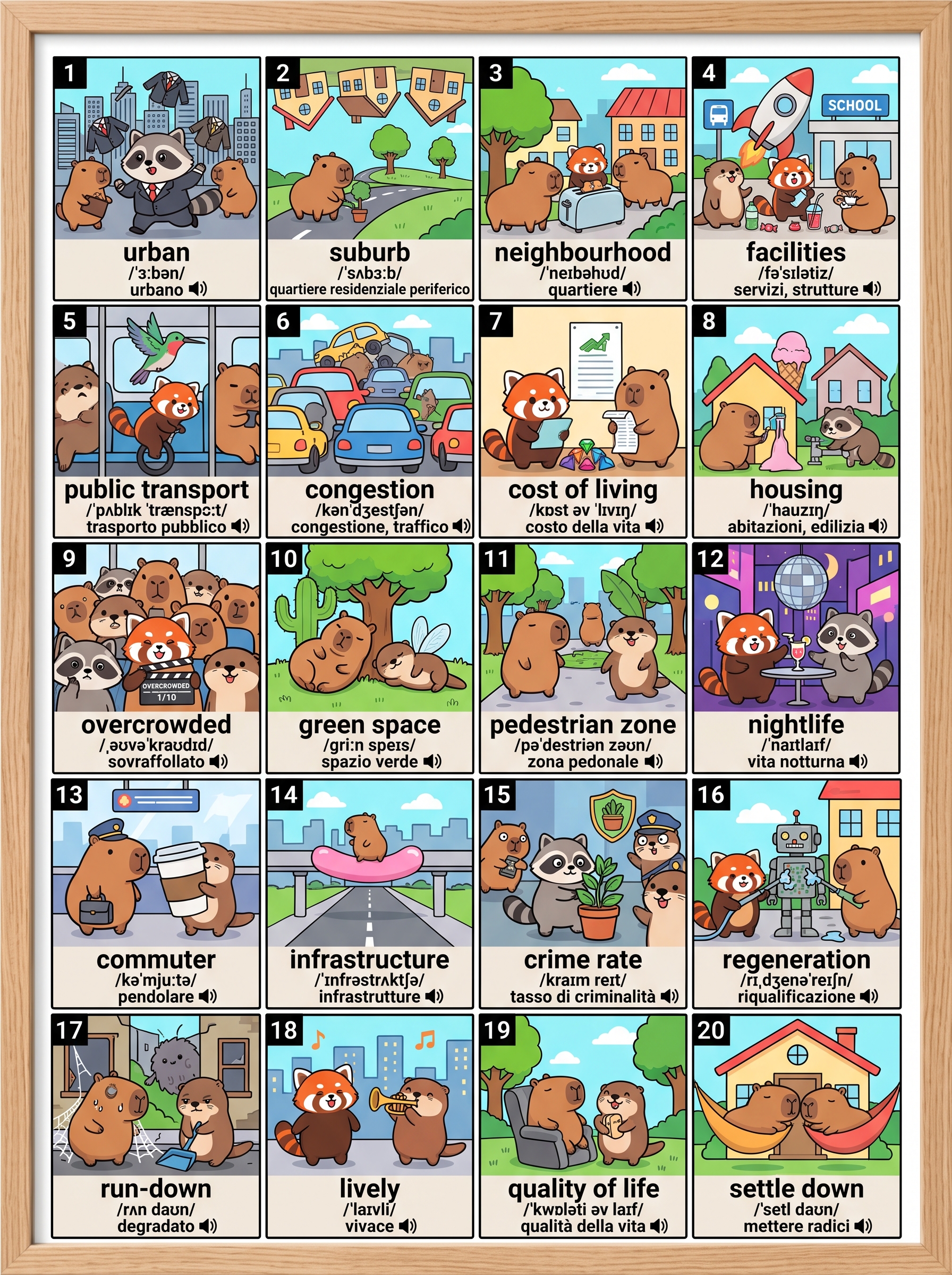
City Life & Urban Living — 20 high-frequency words, with pronunciation, collocations, easy-to-confuse words and four interactive exercises.
📌 In this lesson
🎯 Lesson goal
Discussing the pros and cons of urban life 🏙️ with the vocabulary you need for a B2 essay: services, cost of living, traffic, crime, green spaces. It includes the structures for comparing city and countryside that appear in written exams. 🚀
🗂️ Word Bank
Tap 🔊 to hear the British pronunciation. The IPA transcription is under each word.
📖 Words in context
Stay in the city or leave? · tap a highlighted word to hear it.
Every year thousands of young people move to the city for work, and every year some of them move back. The argument is always the same.
On one side: facilities. A big urban centre offers universities, hospitals, nightlife and public transport that actually runs at night. Areas that were run-down twenty years ago have been transformed by regeneration projects, and a good neighbourhood near a pedestrian zone can be genuinely lively.
On the other: the cost of living. Decent housing is expensive, the flats are small, the buses are overcrowded and traffic congestion wastes an hour a day. Every commuter knows the feeling. Many people conclude that a suburb, or a town with more green space, offers a better quality of life — and that is where they eventually decide to settle down.
🔗 Collocations & chunks
Words travel in pairs, not alone: learn the whole chunk.
| Chunk / collocation | Meaning | Example |
|---|---|---|
| on the outskirts of the city | at the edge of a city | They live on the outskirts of the city. |
| a stone's throw from | very close to | It's a stone's throw from the station. |
| hustle and bustle | noisy, busy confusion in a city | I miss the hustle and bustle. |
| improve public services | to make buses, schools and hospitals better | The council promised to improve public services. |
| tackle traffic congestion | to deal with busy roads | The mayor wants to tackle traffic congestion. |
| a sense of community | a feeling of belonging to a group | Small towns have a stronger sense of community. |
⚠️ Easy-to-confuse words
| English word | Real meaning ✅ | Easy to mix up with ❌ |
|---|---|---|
| village | a very small town in the countryside | A holiday village for tourists is a holiday resort |
| popular | liked by many people | Not “of ordinary people”: that is working-class |
| comfortable | easy to use and close by | For “not expensive”, say cheap or affordable |
| local | of the area; also a neighbourhood pub | Not a nightclub: that is a club or venue |
🎚️ Register: when to use them
| Expression | Register | When to use it |
|---|---|---|
| It's a bit of a dump. | very informal | between friends, a harsh opinion of an area |
| It's not the nicest area. | understatement cortese | to criticise without being rude |
| The district suffers from underinvestment. | formal | essays, reports, exams |
| On balance, urban living offers… | academic | a perfect phrase for the end of an essay |
🚫 Common mistakes to avoid
| Mistake ❌ | Correct ✅ |
|---|---|
| I live in the periphery. | I live on the outskirts. |
| The traffic are terrible. | The traffic is terrible. |
| There are many possibilities of work here. | There are many job opportunities here. |
| In my city there is a lot of movement. | My city is very lively. |
🎮 Vocabulary gym
Four ways to practise the same 20 words. Your progress is saved on this device.
Tap the card to flip it.
Tap an English word, then its meaning. Eight pairs per round.
Complete the ten sentences with the right word. The clue under each sentence will help you.
- areas are growing fast.💡 Areas full of buildings and people are growing fast.
- They moved to a quiet .💡 They moved to a quiet housing area at the edge of the city.
- It's a friendly .💡 It is a friendly part of town.
- The area has excellent .💡 The area has excellent public buildings and services.
- here runs until midnight.💡 Buses and trains for everyone run until midnight here.
- Traffic costs the city millions.💡 Too many vehicles on the road cost the city millions.
- The has risen sharply.💡 The money needed for daily life has risen sharply.
- Affordable is scarce.💡 There are few cheap homes for people to live in.
- The trains are at eight.💡 Trains are too full of people at eight.
- Every district needs more .💡 Every neighbourhood needs more areas with grass and trees.