
Grammarl Inversion & Emphasis (C1/C2)
📌 Lesson contents
🎯 Lesson goal (C1/C2)
At C1/C2 level, varying your sentence structure is key to a more elegant style. Grammarl inversion (swapping the subject and the auxiliary) and cleft sentences let you emphasise exactly the part of the sentence you want, with a natural, native-like feel. 🚀
🌟 1. Inversion with Negative or Limiting Adverbs
When a negative or limiting adverb comes at the start of a sentence for emphasis or a dramatic style, the word order changes: Adverb + Auxiliary + Subject + Verb.
| Adverbial expression | Structure / Partner word | Example |
|---|---|---|
| Hardly / Scarcely / Barely | … when … (Past Perfect + Past Simple) | Hardly had I entered the room when the alarm sounded. |
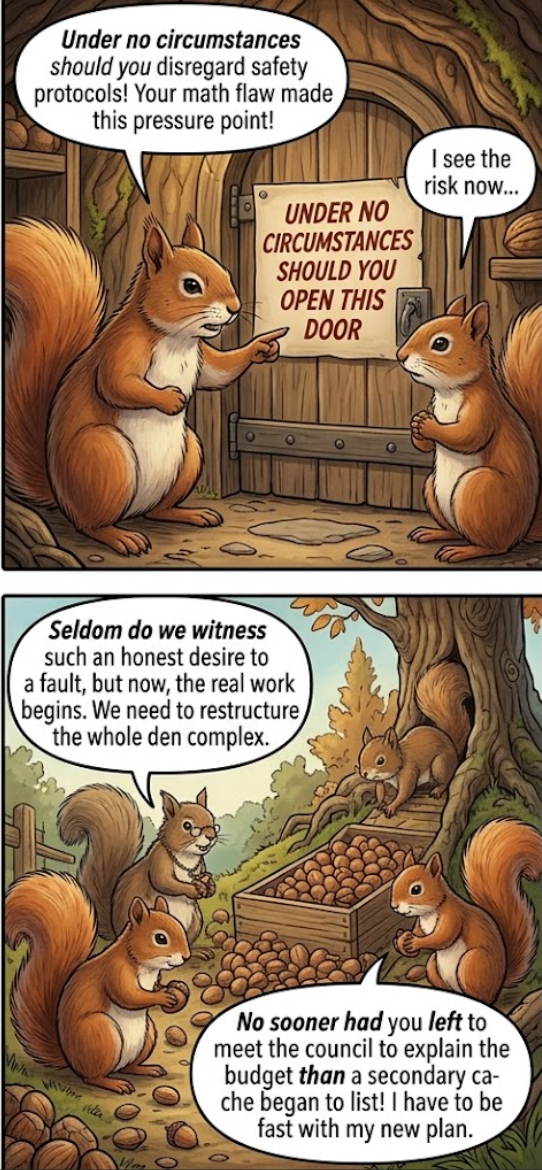
| No sooner | … than … (Past Perfect + Past Simple) | No sooner had she left than it began to rain. |
| Seldom / Rarely / Little | Direct inversion of the auxiliary | Seldom do we witness such dedication. |
| Under no circumstances / On no account | Inversion with a modal or Do/Be | Under no circumstances should you open this door. |
| Not until / Only after / Only when | The inversion happens in the main clause | Not until the meeting ended did he realize his mistake. |
⏱️ 2. Cleft Sentences
Cleft sentences “isolate” the new or important information by splitting a clause into two parts:
- It-clefts:
It + be + [emphasised element] + that/who...
“It was Marco who called the police last night.” (Emphasises Marco). - Wh-clefts (Pseudo-clefts):
What... + be + [emphasised element]
“What I really need is a few days of rest.” (Emphasises the rest). - All-clefts:
All (that)... + be + [emphasised element]
“All she wanted was a second chance.” (Emphasises ‘a second chance’).
🔗 3. Fronting & Locative Inversion
In descriptive or literary writing, moving a place phrase or an adjective to the start of the sentence swaps the subject and the main verb (without ‘do’):
- Locative inversion: At the top of the hill stood an ancient castle.
- Adjective at the start: Crucial to the project’s success is team cohesion.
🚫 Common mistakes to avoid
| C1/C2 Mistake ❌ | Correct ✅ |
|---|---|
| No sooner had I arrived when the phone rang. | No sooner had I arrived than the phone rang. (‘No sooner’ needs ‘than’, while ‘hardly/scarcely’ need ‘when’!). |
| Not until yesterday I found out the truth. | Not until yesterday did I find out the truth. (The auxiliary inversion is missing!). |
| Not until she came I was able to leave. | Not until she came was I able to leave. (With ‘Not until’, the inversion goes in the main clause, not in the subordinate clause!). |
1. Gap Fill & Transformation Test (15 Questions)
Complete the inverted or emphatic sentences with the correct missing words.
2. Extra: Sentence Builder 🧩
Tap the words to move them and build perfect sentences with inversion or cleft sentences!