
Corpo e salute
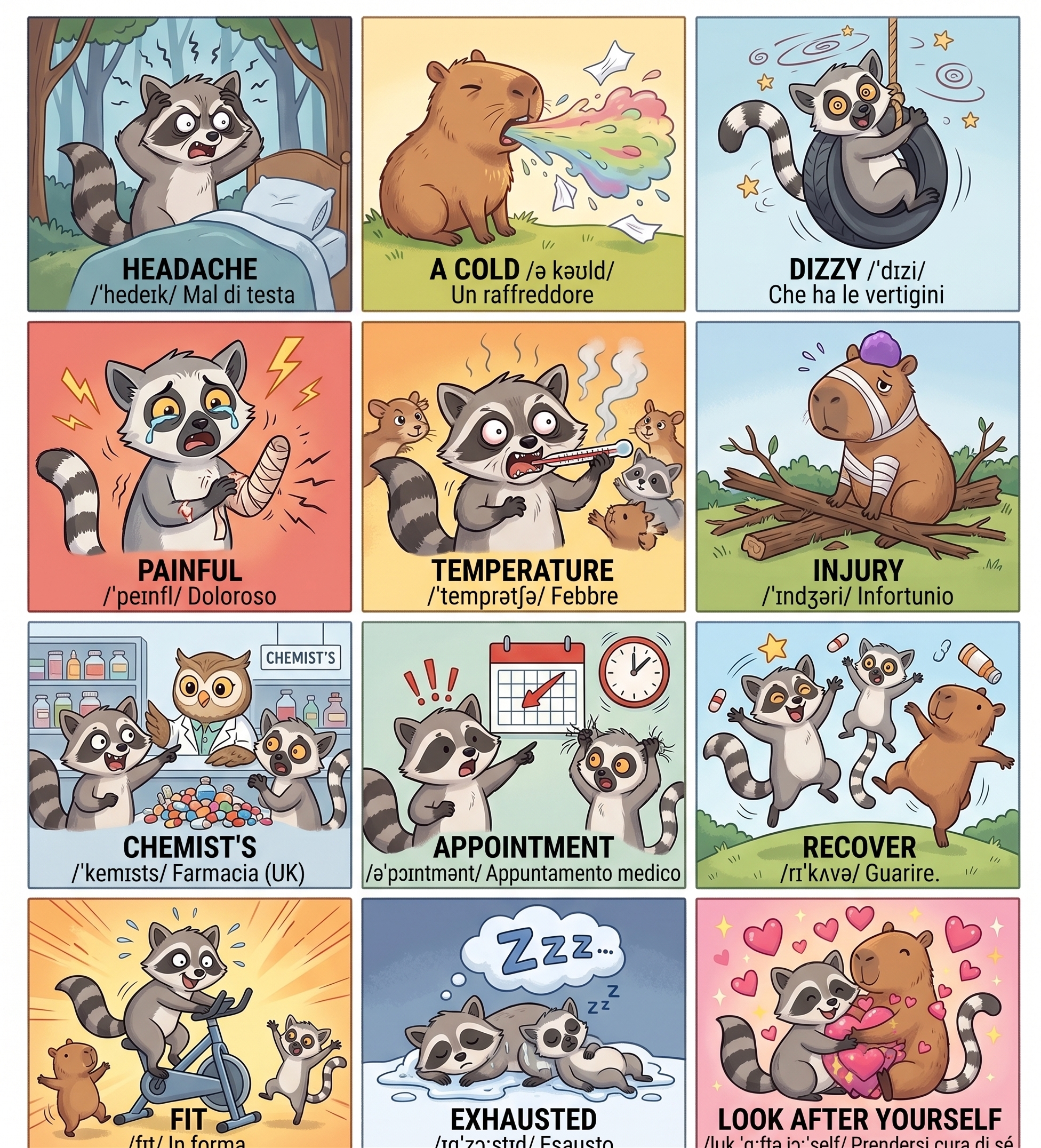
Body & Health — 20 parole ad alta frequenza, con pronuncia, collocations, falsi amici e quattro esercizi interattivi.
📌 Indice della lezione
🎯 Obiettivo della lezione
Le parole per spiegare a un medico che cosa non va 🩺, utilissime in viaggio. Il punto chiave è la costruzione dei sintomi: si usa have (I have a headache) oppure -ache attaccato alla parte del corpo. Impari anche i consigli con should. 🚀
🗂️ Word Bank
Tocca 🔊 per ascoltare la pronuncia britannica. La trascrizione IPA è sotto ogni parola.
📖 Le parole in contesto
Dal medico, in Inghilterra · tocca una parola evidenziata per sentirla.
On Monday I woke up with a headache and a sore throat. By the evening I also had a bad cough and a high temperature, so my host family said I had caught a cold.
On Tuesday I still felt dizzy when I stood up, so we made an appointment at the doctor's surgery. The doctor was kind: he said it was nothing serious, wrote me a prescription and told me to rest.
We went to the chemist's and bought a painkiller. "Drink water, sleep well and look after yourself," he said. It took four days to recover. I was exhausted, but on Saturday I felt fit again — just in time for the football match.
🔗 Collocations & chunks
Le parole si imparano in coppia, non da sole: memorizza il blocco intero.
| Chunk / collocation | Traduzione | Esempio |
|---|---|---|
| catch a cold | prendere un raffreddore | I always catch a cold in October. |
| feel under the weather | sentirsi poco bene | I'm feeling a bit under the weather. |
| get over an illness | riprendersi da una malattia | It took ages to get over the flu. |
| keep fit | mantenersi in forma | She swims to keep fit. |
| be off sick | essere assente per malattia | He's been off sick all week. |
| get well soon | guarisci presto | Get well soon! |
⚠️ False Friends per italiani
| Parola inglese | Significato vero ✅ | Trappola per italiani ❌ |
|---|---|---|
| sensible | assennato | NON «sensibile» → sensitive |
| morbid | morboso, macabro | NON «morbido» → soft |
| suffer from | soffrire di (una malattia) | NON «soffrire» in senso emotivo generico → be in pain / struggle |
| terrific | fantastico | NON «terrificante» → terrifying |
🎚️ Registro: quando usarle
| Espressione | Registro | Quando usarla |
|---|---|---|
| I'm knackered. | molto informale (UK) | tra amici: «sono a pezzi». Mai con un medico |
| I don't feel very well. | neutro | sempre appropriato, anche a scuola o al lavoro |
| I'm feeling under the weather. | informale-cortese | per dire che non stai bene senza dettagli |
| I've been experiencing chest pain. | formale | quando descrivi sintomi a un medico |
🚫 Errori comuni da evitare
| Errore ❌ | Corretto ✅ |
|---|---|
| I have mal di testa. | I have a headache. |
| I am cold. | I have a cold. (se sei malato) |
| I have 38 of fever. | I have a temperature of 38. |
| The doctor gave me a recipe. | The doctor gave me a prescription. |
🎮 Palestra lessicale
Quattro modi di allenare le stesse 20 parole. I progressi restano salvati su questo dispositivo.
Tocca la carta per girarla.
Tocca una parola inglese, poi la sua traduzione. Otto coppie per serie.
Completa le dieci frasi con la parola giusta. La traduzione italiana è l’indizio.
- I've got a terrible .🇮🇹 Ho un terribile mal di testa.
- She has a and a cough.🇮🇹 Ha mal di gola e tosse.
- That sounds bad.🇮🇹 Quella tosse suona brutta.
- I've caught .🇮🇹 Ho preso un raffreddore.
- He's got a high .🇮🇹 Ha la febbre alta.
- I feel on buses.🇮🇹 Mi viene la nausea in autobus.
- I stood up and felt .🇮🇹 Mi sono alzato e ho avuto le vertigini.
- My knee is very .🇮🇹 Il ginocchio mi fa molto male.
- He has a knee .🇮🇹 Ha un infortunio al ginocchio.
- I've got a big on my arm.🇮🇹 Ho un grosso livido sul braccio.