
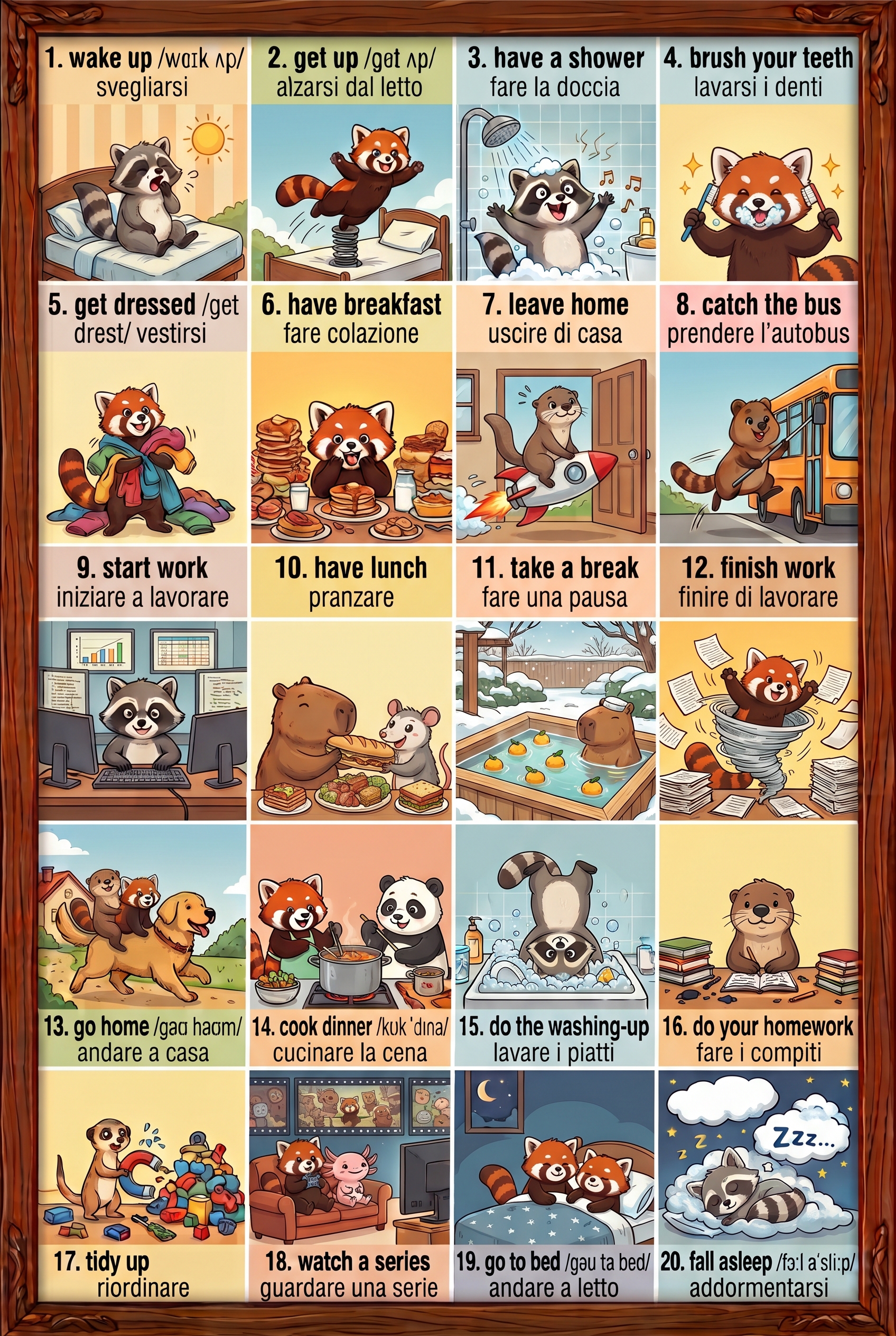
Daily Routine
Daily Routine — 20 high-frequency words, with pronunciation, collocations, false friends and four interactive exercises.
📌 Lesson contents
🎯 Lesson aim
In this lesson you learn 20 expressions for describing a typical day in English ⏰. Not single words, but verb blocks ready to use — have breakfast, catch the bus, go to bed — the ones learners often get wrong by translating word for word. At the end, test yourself with four exercises. 🚀
🗂️ Word Bank
Tap 🔊 to hear the British pronunciation. The IPA transcription is under each word.
📖 Words in context
A day in the life of Lucia, a student in Bristol · tap a highlighted word to hear it.
On weekdays I have to wake up at six thirty, but I only get up when the second alarm rings. I have a shower, then I get dressed and run to the kitchen.
I never have time to have breakfast at the table, so I take a biscuit and leave home at ten to eight. I catch the bus in front of the bakery. At school my friends and I take a break at eleven.
In the afternoon I do your homework — well, my own homework — then I help my mum cook dinner. Afterwards nobody wants to do the washing-up! At ten my brother and I watch a series, and at eleven I go to bed. I usually fall asleep before the end of the first episode.
🔗 Collocations & chunks
Words are learned in pairs, not alone: memorise the whole chunk.
| Chunk / collocation | Meaning | Example |
|---|---|---|
| wake up early | to start the day early | I wake up early on weekdays. |
| have a quick breakfast | a fast morning meal | I only have a quick breakfast. |
| get ready | to prepare yourself to go out | Give me ten minutes to get ready. |
| be late for school | to arrive after lessons have started | Hurry up or you'll be late for school. |
| run out of time | to have no time left | I ran out of time this morning. |
| have an early night | to get into bed early in the evening | I'm tired — I'll have an early night. |
⚠️ Tricky Words and Traps
| English word | Real meaning ✅ | Common trap ❌ |
|---|---|---|
| actually | in fact, really | Don’t use it to mean “now” → say at the moment / currently |
| attend | to go to a class or an event | It doesn’t mean “wait” → say wait |
| camera | a machine for taking photos | It isn’t a room → say room / bedroom |
| eventually | in the end, after a long time | It doesn’t mean “possibly” → say possibly / if necessary |
🎚️ Register: when to use them
| Expression | Register | When to use it |
|---|---|---|
| Rise and shine! | very informal | to wake someone up at home, in a funny way |
| Wake up! | informal | with friends, flatmates, family |
| I get up at seven. | neutral | fine in any situation, even at school |
| I rise at seven. | formal / literary | almost never spoken: you find it in written texts |
🚫 Common mistakes to avoid
| Mistake ❌ | Correct ✅ |
|---|---|
| I wake up me at seven. | I wake up at seven. |
| I go to the bed at eleven. | I go to bed at eleven. |
| Every morning I make the homework. | Every morning I do my homework. |
| I have the breakfast at eight. | I have breakfast at eight. |
🎮 Vocabulary gym
Four ways to practise the same 20 words. Your progress is saved on this device.
Tap the card to flip it.
Tap an English word, then its meaning. Eight pairs per round.
Complete the ten sentences with the right word. The short hint is your clue.
- I usually at half past six.💡 I usually stop sleeping at half past six.
- I five minutes after the alarm.💡 I leave my bed five minutes after the alarm.
- I before breakfast.💡 I wash myself under the water before breakfast.
- Don't forget to .💡 Remember to clean your teeth.
- I in five minutes.💡 I put my clothes on in five minutes.
- We together on Sundays.💡 We eat the first meal of the day together on Sundays.
- I at ten to eight.💡 I go out of my house at ten to eight.
- I outside the school.💡 I get on the bus in front of the school.
- I at nine o'clock.💡 I begin my job at nine o’clock.
- We at half past twelve.💡 We eat the midday meal at half past twelve.