
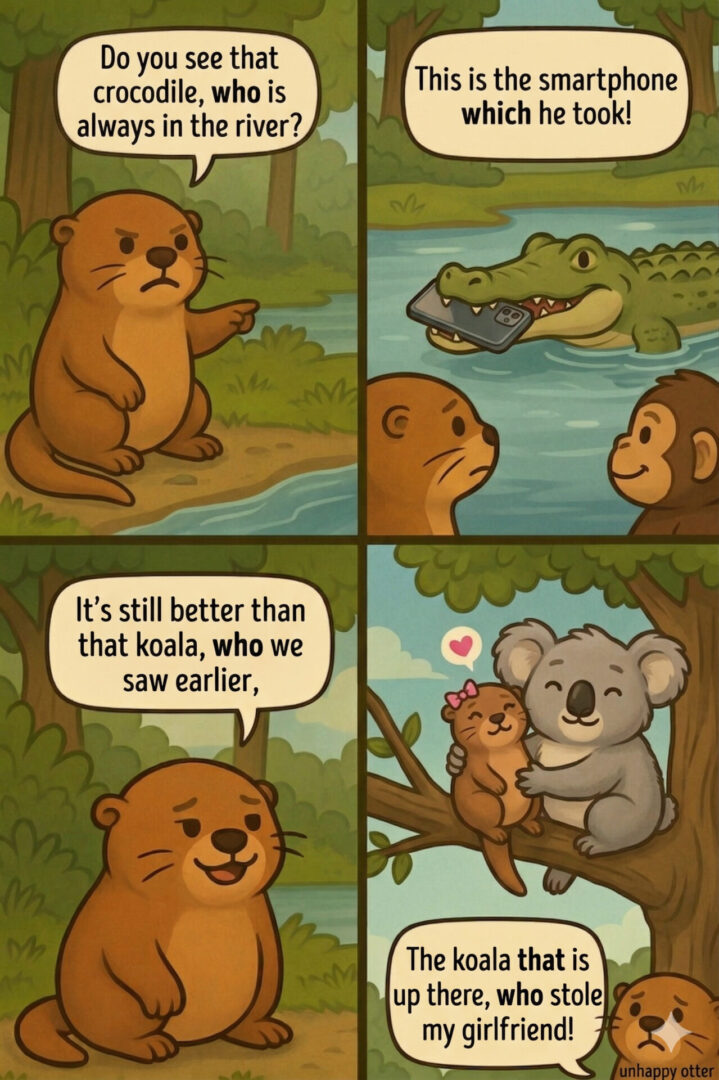
Le Relative Clauses (Proposizioni Relative)
🎯 Obiettivo della lezione
In questa lezione imparerai a usare le Relative Clauses per unire due frasi e dare maggiori informazioni su una persona, cosa o luogo.
Capirai la differenza tra Defining (essenziali) e Non-Defining (extra) e farai subito pratica reale!
🤔 Cosa sono e i Pronomi Relativi
Usiamo le relative clauses per evitare di ripetere lo stesso soggetto o oggetto. Si introducono con i Pronomi Relativi:
- Who / That: Per le persone.
- Which / That: Per le cose e gli animali.
- Where: Per i luoghi.
- Whose: Per il possesso (il cui/la cui).
- When: Per il tempo.
🛠 Come si formano? (I due tipi)
1. Defining Relative Clauses (Informazione Essenziale)
Danno un’informazione necessaria per capire di chi o cosa stiamo parlando. Non si usano le virgole.
- The man who lives next door is a doctor.
➔ (L’uomo che vive qui accanto è un medico. – Senza la relativa non sapremmo di quale uomo parlo!) - The book that I bought yesterday is great.
2. Non-Defining Relative Clauses (Informazione Extra)
Danno un’informazione aggiuntiva. La frase avrebbe senso anche senza. Si usano sempre le virgole. Attenzione: non si usa MAI “that” in questo caso.
- My brother, who lives in London, is a doctor.
➔ (Mio fratello, che vive a Londra, è un medico. – Ho un solo fratello, l’informazione è extra.) - The Eiffel Tower, which is in Paris, is beautiful.
📊 Schema riassuntivo
| Tipo | Uso di virgole? | Posso usare “That”? | Posso omettere il pronome? |
|---|---|---|---|
| Defining | ❌ No | ✅ Sì (al posto di who/which) | ✅ Sì, se il pronome NON è il soggetto del verbo che segue. |
| Non-Defining | ✅ Sì, sempre | ❌ Mai | ❌ Mai |
❓ Dubbi basilari chiariti
Quando posso “cancellare” (omettere) il pronome relativo?
➔ Solo nelle Defining clauses, e solo se il pronome è seguito da un pronome personale o un nome (è l’oggetto, non il soggetto della relativa).
The girl (who) I met yesterday is nice. (Posso ometterlo: dopo c’è “I”)
The girl who works here is nice. (NON posso ometterlo: dopo c’è il verbo “works”)
❌ Errori comuni da evitare
- Usare “that” tra due virgole:
❌ My car, that is very old, broke down.
✅ My car, which is very old, broke down. - Ripetere il pronome personale (he, she, it):
❌ The man who he called me is my boss.
✅ The man who called me is my boss.
✅ Esercizi Pratici
Test A
1. Gap Fill: Inserisci il pronome relativo corretto (who, which, where, whose).
- The restaurant __________ we had dinner last night was excellent.
- I talked to the woman __________ car had broken down in front of the shop.
- This is the phone __________ I bought last week.
- Tom, __________ is my best friend, is moving to New York.
2. Error Correction: Trova l’errore, correggilo e leggi la spiegazione.
- Rome, that is the capital of Italy, is very old.
- The boy who he is talking to the teacher is my brother.
3. Vocabulary: Abbina i termini inglesi alla loro traduzione.
- A. To break down
- B. To move (to a city)
- C. Excellent
- D. Capital
1. Eccellente – 2. Rompersi (mezzi di trasporto) – 3. Capitale – 4. Trasferirsi
👉 Clicca qui per le soluzioni e spiegazioni del Test A
1. Gap Fill:
- 1. where (indica un luogo in cui avviene un’azione).
- 2. whose (indica possesso: la cui macchina).
- 3. which / that (indica un oggetto).
- 4. who (indica una persona in una non-defining clause).
2. Error Correction:
- 1. Rome, which is the capital… (Spiegazione: “That” non si può mai usare nelle frasi con le virgole / non-defining clauses).
- 2. The boy who is talking… (Spiegazione: “Who” fa già da soggetto, non bisogna ripetere “he”).
3. Vocabulary: A-2, B-4, C-1, D-3.
Test B
1. Gap Fill: Unisci le due frasi usando un pronome relativo (fai attenzione se servono le virgole!).
- I sent an email to my boss. He is on holiday. ➔ My boss, ________ is on holiday, received my email.
- We went to the beach. We often swim there. ➔ We went to the beach ________ we often swim.
- He is the man. His dog bit me. ➔ He is the man ________ dog bit me.
- I found the keys. I lost them yesterday. ➔ I found the keys ________ I lost yesterday.
2. Error Correction: Trova l’errore, correggilo e leggi la spiegazione.
- The hotel where we stayed it was very expensive.
- My sister who is 25 is studying law. (Assumendo che tu abbia una sola sorella).
3. Vocabulary: Abbina i termini inglesi alla loro traduzione.
- A. Holiday
- B. To bite
- C. Expensive
- D. Law
1. Legge (Giurisprudenza) – 2. Vacanza – 3. Costoso – 4. Mordere
👉 Clicca qui per le soluzioni e spiegazioni del Test B
1. Gap Fill:
- 1. who (Non-defining clause, ci vuole “who” per le persone).
- 2. where (Si riferisce al luogo).
- 3. whose (Indica il possesso: il cui cane).
- 4. which / that (Riferito alle chiavi).
2. Error Correction:
- 1. The hotel where we stayed was very expensive. (Spiegazione: Non bisogna ripetere il pronome “it” come soggetto della frase principale, “The hotel” è già il soggetto).
- 2. My sister, who is 25, is studying law. (Spiegazione: Se hai una sola sorella, l’informazione sull’età è extra, quindi serve la non-defining clause con le virgole).
3. Vocabulary: A-2, B-4, C-3, D-1.
I Condizionali 0, 1 e 2 in Inglese
🎯 Obiettivo della lezione
In questa lezione imparerai a usare lo Zero, First e Second Conditional per parlare di verità assolute, situazioni reali future e situazioni ipotetiche.
Capirai come formarli, quando usarli e farai subito pratica reale!
🤔 Cosa sono e quando si usano?
- Zero Conditional: Per parlare di verità generali, dati di fatto o leggi scientifiche. Il risultato è sempre certo.
- First Conditional: Per parlare di situazioni future reali, possibili o molto probabili.
- Second Conditional: Per parlare di situazioni immaginarie, ipotetiche o improbabili nel presente o nel futuro.
🛠 Come si formano?
0. Zero Conditional (Verità Assoluta)
Formula: If + Present Simple, Present Simple
- If you heat water to 100 degrees, it boils.
➔ (Se riscaldi l’acqua a 100 gradi, bolle.)
1. First Conditional (Realtà Futura)
Formula: If + Present Simple, will + verbo base
- If it rains tomorrow, we will stay home.
➔ (Se domani piove, resteremo a casa.)
2. Second Conditional (Immaginazione/Ipotesi)
Formula: If + Past Simple, would + verbo base
- If I had a million dollars, I would buy an island.
➔ (Se avessi un milione di dollari, comprerei un’isola.)
📊 Schema riassuntivo
| Tipo | Parte con “If” (Condizione) | Parte principale (Risultato) | Uso |
|---|---|---|---|
| Zero (0) | If + Present Simple | Present Simple | Fatti sempre veri, scienza |
| First (1) | If + Present Simple | will + verbo base | Futuro probabile/possibile |
| Second (2) | If + Past Simple | would + verbo base | Presente/Futuro immaginario |
❓ Dubbi basilari chiariti
Si può invertire l’ordine della frase?
➔ Sì! Puoi mettere la parte con “If” alla seconda metà della frase. In questo caso, non serve la virgola.
Water boils if you heat it to 100 degrees.
Nel Second Conditional si usa “was” o “were”?
➔ Nelle situazioni ipotetiche, è molto comune (e grammaticalmente più corretto) usare were per tutte le persone, specialmente per dare consigli.
If I were you, I would study more. (Se fossi in te, studierei di più)
❌ Errori comuni da evitare
- Usare il futuro nella parte con “If” nel First Conditional:
❌ If it will rain, I will stay home.
✅ If it rains, I will stay home. - Usare il presente invece del passato nel Second Conditional:
❌ If I have money, I would travel.
✅ If I had money, I would travel.
📝 Riepilogo finale
Zero ➔ Se succede X, succede Y (Sempre vero).
First ➔ Se succede X, succederà Y (Possibile/Probabile).
Second ➔ Se succedesse X, succederebbe Y (Immaginario/Ipotetico).
✅ Esercizi Pratici
Test A
1. Gap Fill: Completa le frasi con il condizionale corretto (Zero, First o Second).
- If babies are hungry, they __________ (cry).
- If she __________ (call) me tonight, I will answer.
- If I won the lottery, I __________ (quit) my job immediately.
- Ice melts if you __________ (leave) it in the sun.
2. Error Correction: Trova l’errore, correggilo e leggi la spiegazione.
- If I will be late, I will text you.
- If she knows his number, she would call him.
3. Vocabulary: Abbina i termini inglesi alla loro traduzione.
- A. To melt
- B. To cry
- C. To quit (a job)
- D. To text
1. Piangere – 2. Inviare un messaggio – 3. Sciogliersi – 4. Licenziarsi
👉 Clicca qui per le soluzioni e spiegazioni del Test A
1. Gap Fill:
- 1. cry (Zero Conditional: Fatto sempre vero in natura. Present Simple + Present Simple).
- 2. calls (First Conditional: Azione futura possibile. If + Present Simple).
- 3. would quit (Second Conditional: Situazione immaginaria. If + Past Simple, would + verbo).
- 4. leave (Zero Conditional: Legge fisica).
2. Error Correction:
- 1. If I am late… (Spiegazione: Mai usare “will” subito dopo “if”. La condizione vuole il Present Simple).
- 2. If she knew his number… (Spiegazione: Essendoci “would” nella principale, è un Second Conditional. Serve il Past Simple dopo “if”).
3. Vocabulary: A-3, B-1, C-4, D-2.
Test B
1. Gap Fill: Completa le frasi con il condizionale corretto (Zero, First o Second).
- If I __________ (be) you, I would apologize to her.
- Plants die if they __________ (not get) enough water.
- If we hurry, we __________ (catch) the 8:00 train.
- What would you do if you __________ (find) a wallet on the street?
2. Error Correction: Trova l’errore, correggilo e leggi la spiegazione.
- If you mix red and yellow, you will get orange. (Parlando in generale)
- I would travel more if I have more free time.
3. Vocabulary: Abbina i termini inglesi alla loro traduzione.
- A. To apologize
- B. To catch (a train)
- C. Wallet
- D. To mix
1. Mescolare – 2. Chiedere scusa – 3. Portafoglio – 4. Prendere (un mezzo)
👉 Clicca qui per le soluzioni e spiegazioni del Test B
1. Gap Fill:
- 1. were (Second Conditional: Per dare consigli si usa “If I were you”).
- 2. don’t get / do not get (Zero Conditional: Fatto scientifico. Present Simple negativo).
- 3. will catch (First Conditional: Situazione reale e probabile a breve termine).
- 4. found (Second Conditional: Situazione ipotetica, richiede il Past Simple).
2. Error Correction:
- 1. If you mix red and yellow, you get orange. (Spiegazione: Essendo un fatto sempre vero, è uno Zero Conditional. Si usa il Present Simple in entrambe le frasi).
- 2. …if I had more free time. (Spiegazione: “would travel” indica un Second Conditional, quindi la if-clause deve essere al Past Simple).
3. Vocabulary: A-2, B-4, C-3, D-1.
Mega Ripasso: Condizionali e Relative Clauses
Ecco un rapido ripasso teorico prima di affrontare la simulazione da 30 domande. Le regole essenziali per completare l’esercizio sono riassunte qui sotto.
1. I Condizionali
- Zero (Sempre vero):
If + Present Simple, Present Simple.
(If you heat ice, it melts) - First (Probabile):
If + Present Simple, will + verbo.
(If it rains, I will stay home) - Second (Immaginario):
If + Past Simple, would + verbo.
(If I had money, I would travel)
Regola d’oro: Mai usare “will” o “would” subito dopo “if”!
2. Relative Clauses
- Who: per le persone.
- Which: per cose e animali.
- Where: per i luoghi.
- Whose: per il possesso (il cui/la cui).
- That: può sostituire who/which, ma MAI nelle frasi tra due virgole (Non-Defining).
✅ Esercitazione Pratica (30 Frasi)
Parte 1 (Domande 1-15): Inserisci il verbo corretto per formare lo Zero, First o Second Conditional.
Parte 2 (Domande 16-30): Inserisci il pronome relativo corretto (who, which, where, whose, that).
Scrivi tutto in minuscolo e senza spazi extra.
- If you freeze water, it (become) solid. [0 Cond]
- If I (have) a million dollars, I would buy a boat. [2nd Cond]
- She will pass the exam if she (study) hard. [1st Cond]
- If it (rain) tomorrow, we will stay home. [1st Cond]
- If I were you, I (not/do) that. [2nd Cond]
- Plants (die) if you don’t water them. [0 Cond]
- If he calls me tonight, I (answer). [1st Cond]
- What would you do if you (see) a ghost? [2nd Cond]
- If we (leave) now, we will catch the train. [1st Cond]
- I would travel the world if I (be) rich. [2nd Cond]
- If you mix red and white, you (get) pink. [0 Cond]
- If she (know) the truth, she would be very angry. [2nd Cond]
- I (help) you if I had more time. [2nd Cond]
- If they don’t hurry, they (miss) the flight. [1st Cond]
- Ice melts if you (heat) it. [0 Cond]
- The man is standing there is my uncle.
- The book I am reading is very interesting.
- The hotel we stayed last summer was amazing.
- That is the girl brother is a famous actor.
- Paris, is the capital of France, is beautiful. [Tra virgole]
- The teacher teaches us math is very strict.
- I lost the necklace my grandmother gave me.
- This is the restaurant we had our first date.
- My grandfather, is 90 years old, still drives. [Tra virgole]
- A widow is a woman husband has died.
- The car is parked outside is mine.
- London, my sister lives, is a huge city.
- The students study hard usually get good grades.
- The house I was born is now a museum.
- Albert Einstein, was a great scientist, was born in Germany.